Physical Address:
Navi Mumbai, Maharashtra, India
Contact@navimumbaihub.com
Physical Address:
Navi Mumbai, Maharashtra, India
Contact@navimumbaihub.com

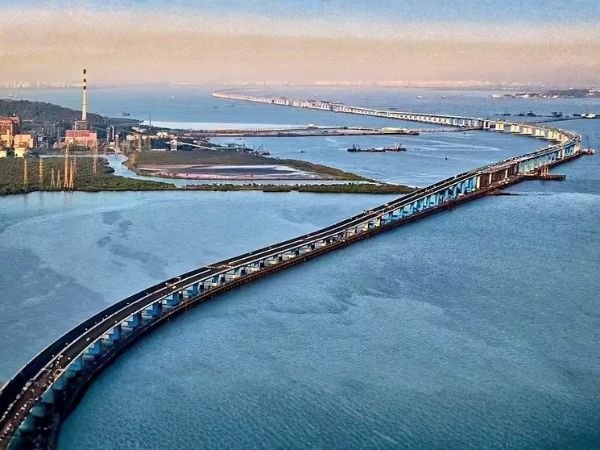
Atal Setu bridge starts at Sewri, Mumbai and ends at Nhava Sheva, Navi Mumbai — spanning 21.8 kilometres across Thane Creek. India’s longest sea bridge was inaugurated by Prime Minister Narendra Modi on January 12, 2024 and has transformed commuting between Mumbai and Navi Mumbai forever
If you live in Navi Mumbai and travel to South Mumbai for work, or if you are considering moving to Navi Mumbai, this guide is essential reading. Here is everything you need to know about Atal Setu in 2026.
As of the latest published MMRDA toll notification. [CONFIRM: toll rates are periodically revised — verify the current figures on MMRDA’s official site before publishing, since a wrong toll amount is a trust-breaking error on a page this visible.]
| Vehicle Type | Single Trip | Return Trip (same day) |
| Car / Jeep / Van | ₹200 | ₹300 |
| Bus / Mini-bus | ₹320 | ₹480 |
| Light Commercial Vehicle (LCV) | ₹655 | ₹985 |
| Truck (2-axle) | ₹715 | ₹1,075 |
| Heavy-duty truck (3-axle+) | ₹1,030 | ₹1,545 |
| Oversized/multi-axle vehicle | ₹1,255 | ₹1,885 |
FASTag is mandatory — there is no cash lane on Atal Setu. Two-wheelers, three-wheelers, autorickshaws, and tractors are not permitted on the bridge at all; it’s cars and above only.
Atal Setu is India’s longest sea bridge, connecting Sewri in Mumbai to Nhava Sheva in Navi Mumbai across Thane Creek. It is part of the larger Mumbai Trans Harbour Link (MTHL) project developed by the Mumbai Metropolitan Region Development Authority (MMRDA).
Key Statistics:
Atal Setu starts at Sewri on the eastern side of Mumbai — accessible via the Eastern Freeway — and ends at Nhava Sheva in Navi Mumbai, connecting to the Mumbai-Pune Expressway and Panvel.
Start Point: Sewri, Mumbai (near Eastern Freeway)
End Point: Nhava Sheva, Navi Mumbai (near JNPT)
Total Length: 21.8 kilometres Over Water: 16.5 kilometres
Key Connections:
Atal Setu (officially the Atal Bihari Vajpayee Sewri–Nhava Sheva Trans Harbour Link) runs 21.8 km in total — about 16.5 km over the sea and roughly 5.3 km of land approach roads — connecting Sewri in South Mumbai to Chirle near Nhava Sheva/Uran in Navi Mumbai.
It’s the longest sea bridge in India, and connects directly onward to the Mumbai-Pune Expressway and the upcoming Navi Mumbai International Airport corridor — worth a one-line mention here since it’s exactly the kind of context that satisfies “atal setu distance” search intent (people asking this are usually trying to gauge commute time, not just kilometres).
Journey time: roughly 20 minutes end-to-end, down from about 2 hours via the older Vashi/Sion-Panvel route.
Speed limit: 100 km/h for cars; lower limits apply on the approach ramps.
Yes — Atal Setu is open 24 hours, 7 days a week.
However, there are some restrictions:
Normal Hours (6 AM to 10 PM): All vehicles permitted
Night Hours (10 PM to 6 AM): Two-wheelers are NOT permitted during night hours for safety reasons. Four-wheelers and above are permitted 24/7.
Peak Traffic Times:
This is where Atal Setu truly shines. The transformation in travel times is dramatic:
| Route | Before Atal Setu | After Atal Setu |
|---|---|---|
| Navi Mumbai to South Mumbai | 60-90 minutes | 20-25 minutes |
| Panvel to BKC | 90-120 minutes | 35-40 minutes |
| Kharghar to South Mumbai | 75-100 minutes | 30-35 minutes |
| Navi Mumbai to Mumbai Airport | 60-90 minutes | 40-50 minutes |
The average daily commuter from Navi Mumbai saves 1 to 1.5 hours every single day.
Over a working year of 250 days, that is 250 to 375 hours saved per year — almost 15 entire days given back to you.
Speed Limit: 100 km/h maximum. Strictly enforced with speed cameras.
Minimum Speed: 40 km/h. Slow moving vehicles are not permitted.
Prohibited Vehicles:
Safety Rules:
Lane Discipline:
Emergency Services:
At Toll Plaza:
Atal Setu is not just a bridge. It is a catalyst for Navi Mumbai’s transformation:
Property Values: Areas closest to the Nhava Sheva end — particularly Ulwe, Dronagiri and Panvel — have seen significant property appreciation since inauguration.
Business Expansion: Many Mumbai-based businesses are now considering Navi Mumbai for office spaces given the improved connectivity.
Airport Synergy: Combined with the upcoming Navi Mumbai International Airport, Atal Setu positions Navi Mumbai as a genuine alternative business and residential hub to Mumbai.
JNPT Cargo: The bridge significantly improves cargo movement between JNPT (India’s largest container port) and Mumbai, benefiting India’s trade and logistics sector.
Q1. Can bikes use Atal Setu?
No
Q2. What is the toll for Atal Setu?
₹200 for a single trip and ₹300 for a same-day return trip for cars, as of the latest MMRDA toll notification. Commercial vehicle rates are higher — see the full table above.
Q3. How long does it take to cross Atal Setu?
At normal speeds, crossing takes approximately 12-15 minutes. With toll and approach roads, budget 20-25 minutes total.
Q4. Is FASTag mandatory on Atal Setu?
FASTag is not mandatory but is strongly recommended. Cash lanes are available but significantly slower.
Q5. What is the speed limit on Atal Setu?
100 km/h maximum. Minimum speed is 40 km/h. Speed cameras are active throughout.
Q6. Can I stop to take photos on the bridge?
Absolutely not. Stopping anywhere on the bridge is strictly prohibited for safety reasons.
Q7. What is the total distance of the Atal Setu bridge?
21.8 km in total — about 16.5 km over water and 5.3 km of land approach roads — connecting Sewri (Mumbai) to Chirle, near Nhava Sheva/Uran (Navi Mumbai).
For daily commuters between Navi Mumbai and South Mumbai or BKC — absolutely yes. Saving 60-90 minutes per day while sitting in traffic versus ₹250 toll is a straightforward decision for most professionals.
For occasional travellers — it depends on your time sensitivity. If you are not in a rush and want to save the toll, the older routes via Sion-Panvel Highway or Eastern Express Highway remain available.
For businesses — the improved connectivity between JNPT, Navi Mumbai and South Mumbai makes Atal Setu invaluable for logistics and operations.
Atal Setu is unquestionably one of the best infrastructure investments Mumbai Metropolitan Region has ever made.
Last Updated: June 2026