Physical Address:
Navi Mumbai, Maharashtra, India
Contact@navimumbaihub.com
Physical Address:
Navi Mumbai, Maharashtra, India
Contact@navimumbaihub.com

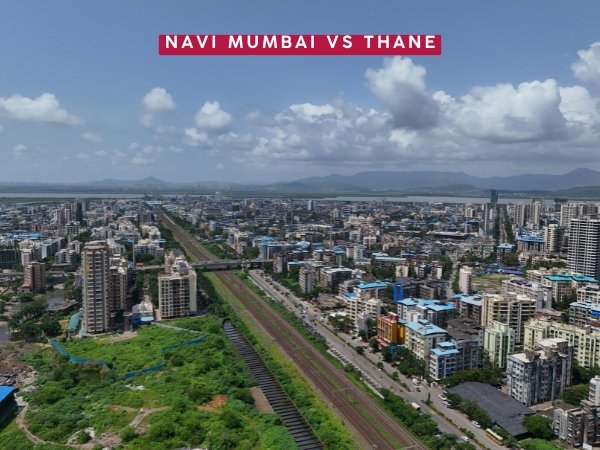
This comes up constantly — someone’s deciding to leave central Mumbai or move to the city for the first time, and the same two names keep coming up: Navi Mumbai and Thane. Both offer more space and cleaner air than the island city. Both have become genuine investment and lifestyle destinations in their own right. But they’re not the same, and the right answer depends heavily on where you actually need to be day to day.
This is the single most important factor, and it’s the one people underweight the most.
If you’re commuting daily to BKC or South Mumbai, Atal Setu has genuinely tilted the calculus toward Navi Mumbai in a way that wasn’t true even three years ago — the bridge cuts a 60–90 minute crawl down to 20–25 minutes. Thane doesn’t have an equivalent shortcut to that specific commute.
Property price comparisons between the two cities get complicated because both have wide internal ranges — a flat in central Thane costs very differently from one in Kalyan-adjacent Thane extensions, just as Vashi differs enormously from Ulwe.
| Segment | Navi Mumbai (approx. per sq ft) | Thane (approx. per sq ft) |
|---|---|---|
| Premium/established (Vashi / central Thane) | ₹15,000–20,000+ | ₹14,000–19,000 |
| Mid-segment (Kharghar / Ghodbunder Road) | ₹10,000–14,000 | ₹9,000–13,000 |
| Emerging/affordable (Ulwe, Panvel / Kalyan-Dombivli belt) | ₹11,000–14,600 (Ulwe specifically, due to airport proximity) | ₹6,000–9,000 |
The honest takeaway: Thane’s outer stretches (Kalyan, Dombivli, Ghodbunder Road extensions) generally offer lower entry prices than equivalent-distance Navi Mumbai nodes, but Navi Mumbai’s growth story — driven by NMIA, Atal Setu, and metro expansion — has produced sharper appreciation in specific pockets like Ulwe over the past two years.
This is where the two cities diverge most clearly in trajectory, not just current state.
Navi Mumbai’s growth engine right now:
Thane’s growth engine:
Thane has the advantage of being a more mature city overall — its core areas have decades more built-out infrastructure than Navi Mumbai’s newer nodes. Navi Mumbai’s advantage is a genuinely faster growth curve right now, driven by three major infrastructure projects landing in the same few years.
Having spent real time in both:
If you value planned, spacious living with visible greenery, Navi Mumbai — and specifically nodes like Kharghar — edges ahead. If you want denser urban energy with a longer-established social scene, Thane has the edge.
Worth calling out separately since it matters for a meaningful chunk of professionals: Navi Mumbai has a distinct advantage for Pune connectivity via the Mumbai-Pune Expressway, especially post-Atal Setu, which shaves real time off the South Mumbai-to-Pune corridor for anyone routing through Navi Mumbai rather than crossing the city first.
Both cities are well-served at this point, though the specifics vary by node rather than city-wide:
Neither city has a decisive citywide advantage here — it comes down to which specific node you’re comparing.
Based on what actually drives this decision for most people:
Choose Navi Mumbai if:
Choose Thane if:
There’s no universal right answer here — it genuinely comes down to which side of the harbour your daily life actually pulls toward. What’s changed meaningfully in the last two years is that Navi Mumbai’s growth story has accelerated faster than Thane’s, largely because three major infrastructure projects (NMIA, Atal Setu, metro expansion) are landing in the same window. If you’re purely optimizing for growth trajectory and don’t have a strong existing pull toward the northern suburbs, Navi Mumbai currently has the stronger case. If your life is already oriented toward Thane’s side of the map, there’s little reason the current infrastructure wave should change that.
Read Next: Best Areas to Live in Navi Mumbai 2026
Explore More NM: Atal Setu Bridge Guide | Ulwe Area Guide | Kharghar Area Guide