Physical Address:
Navi Mumbai, Maharashtra, India
Contact@navimumbaihub.com
Physical Address:
Navi Mumbai, Maharashtra, India
Contact@navimumbaihub.com

Reading Time: 6 min
Last Updated: June 23, 2026 — Current concessional toll rates are confirmed valid through December 31, 2026.
If you drive between Mumbai and Navi Mumbai, knowing the exact Atal Setu toll charges 2026 before you set off saves you both money and surprises at the plaza. This guide covers the current car rates, the one-way vs return math, the EV exemption, FASTag rules, which vehicles are allowed, speed limits, and the full Sewri–Chirle route — everything a regular commuter actually needs.
For cars, jeeps and vans, the Atal Setu toll charges 2026 are straightforward:
| Trip Type | Toll (Car / Jeep / Van) |
|---|---|
| One-way (single trip) | ₹250 |
| Return trip pass | ₹375 |
| Electric Vehicles (EVs) | Fully exempt — ₹0 |
These concessional rates have been extended by the Maharashtra government through December 31, 2026, and they apply at the toll plazas on both the Sewri (Mumbai) and Chirle (Navi Mumbai) ends of the bridge.
Please note: Toll rates on Atal Setu are set by the government and are subject to revision — especially after the concession period ends. Always confirm the current rate at the toll plaza or the official MMRDA/MTHL channels before you travel.
This is the single most useful thing to know if you cross the bridge and come back the same day. Two separate single trips cost ₹500 (₹250 × 2). The return trip pass costs just ₹375 — saving you ₹125 on every round trip.
If you’re a daily or near-daily commuter, that ₹125 per round trip adds up fast over a month. The rule of thumb: if you know you’re coming back, always buy the return pass, not two singles. Living on the Panvel–Chirle side myself, this is the first habit I’d pass on to anyone new to the bridge — it’s free money left on the table otherwise.
Here’s an angle many commuters miss: all electric vehicles cross Atal Setu completely toll-free. This exemption has been in place since August 2025 and is part of the state’s EV-relief framework. If you drive an EV, you pay nothing at either plaza — a genuine, recurring saving that strengthens the case for going electric if you’re a regular Mumbai–Navi Mumbai commuter.
Atal Setu is a fully FASTag-mandatory corridor. There are no cash payment lanes anywhere on the bridge. Before you enter:
Atal Setu is restricted to four-wheeled motor vehicles and above. The following are not permitted:
Violating these restrictions carries a penalty and possible vehicle impoundment under Maharashtra Highway rules, so don’t attempt the crossing on a two-wheeler — there’s no legal way onto the bridge for one.
The main carriageway speed limit is 100 km/h, with reduced speed limits on the ramps and approaches (drive slowly and watch the posted ramp signs — they are significantly lower than the main deck). A few rules and safety habits to keep in mind:
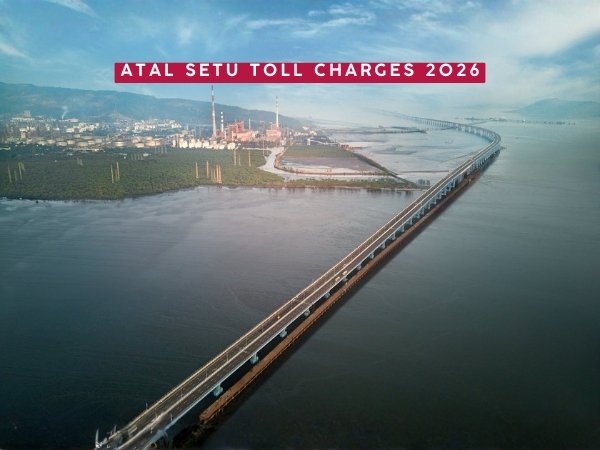
One of the most common points of confusion is where the bridge actually begins and ends. The 21.8 km Atal Setu — officially the Atal Bihari Vajpayee Sewri–Nhava Sheva Atal Setu, and known as the Mumbai Trans Harbour Link (MTHL) — runs from Sewri in South Mumbai to Chirle on the Navi Mumbai mainland side, near Nhava Sheva. Major interchanges sit at Sewri, Shivaji Nagar/Gavhan and Chirle.
The payoff is the time saving: what was once a 90-minute crawl is now a roughly 20-minute drive. For step-by-step navigation and entry/exit guidance, see our Atal Setu directions guide.
This route is also why the bridge matters so much for the region’s growth. By cutting the southern Navi Mumbai corridor — Ulwe, Dronagiri, the Panvel influence belt — much closer to South Mumbai, it has reshaped connectivity to the new Navi Mumbai International Airport ecosystem and the surrounding property market. If you’re weighing where to live or invest along this corridor, our guide to the best areas in Navi Mumbai breaks it down corridor by corridor.
A lot of daily commuters search for an “Atal Setu monthly pass for car,” hoping for a flat monthly rate. As of now, there is no separately published, standardized monthly-pass rate for cars on Atal Setu in the way some other highways offer — the concessional structure is built around the single (₹250) and return (₹375) trips, with FASTag handling each crossing automatically.
If you cross daily, the practical money-saving move is simple: always use the return pass rather than two singles, and keep your FASTag topped up so you never get held at the plaza. If a dedicated commuter or monthly-pass scheme is introduced, we’ll update this section — so check the latest date above.
What is the Atal Setu toll for a car in 2026?
₹250 for a single one-way trip and ₹375 for a return trip, for cars, jeeps and vans. These concessional rates are valid through December 31, 2026.
Is the return pass cheaper than two single trips?
Yes. A return pass is ₹375, versus ₹500 for two separate single trips — a saving of ₹125 per round trip.
Do electric vehicles pay toll on Atal Setu?
No. All EVs are completely toll-exempt and have been since August 2025.
Can I take a two-wheeler on Atal Setu?
No. Motorcycles, scooters, bicycles and pedestrians are banned. Only four-wheeled vehicles and above are allowed, and violations carry penalties.
Is FASTag mandatory on Atal Setu?
Yes. There are no cash lanes — an active FASTag with sufficient balance is required to cross.
Where does Atal Setu start and end?
It runs 21.8 km from Sewri in South Mumbai to Chirle on the Navi Mumbai side, cutting the journey from about 90 minutes to roughly 20 minutes.
What is the toll for Atal Setu?
Car toll is ₹250 one-way, with a discounted return toll within the same day.
What is the distance of the Atal Setu bridge?
Atal Setu runs approximately 21.8 km, making it India’s longest sea bridge, connecting Sewri in Mumbai to Chirle near Ulwe in Navi Mumbai.
Where are the start and end points?
The bridge starts at Sewri (Mumbai side) and ends at Chirle, near Ulwe, close to NMIA.
Is there a monthly pass for Atal Setu?
Yes, MSRDC offers a monthly pass option for frequent commuters — check the toll plaza or MSRDC portal for current pricing.
What is the speed limit on Atal Setu?
The speed limit is 100 km/h for cars and light vehicles, and 40 km/h at the interchanges/ramps.
What is the return toll on Atal Setu?
A discounted ₹375 same-day return toll applies if you cross both ways within 24 hours.
Read Next: Atal Setu Bridge — Full Guide & History · Atal Setu Directions: Entry & Exit Points
Explore More NM: Navi Mumbai International Airport · Best Areas to Live in Navi Mumbai · Navi Mumbai Metro Guide