Physical Address:
Navi Mumbai, Maharashtra, India
Contact@navimumbaihub.com
Physical Address:
Navi Mumbai, Maharashtra, India
Contact@navimumbaihub.com

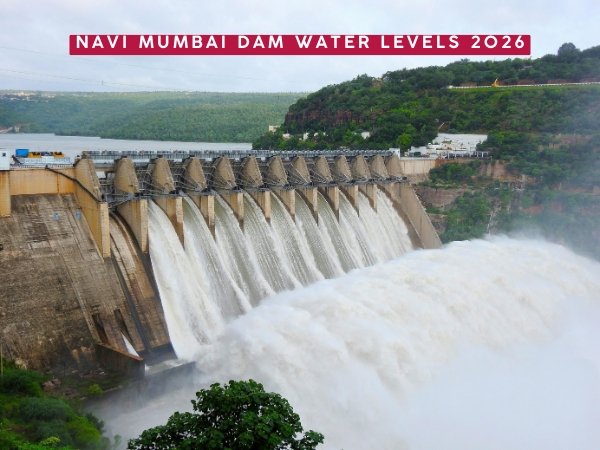
🌧️ Quick answer: As of 27 August 2026, Navi Mumbai’s dam network — Morbe, Hetawane, and Barvi combined — stands at 96.72% of live capacity (6,27,904 ML of 6,49,170 ML designed capacity). More importantly: NMMC officially withdrew the 10% water cut on August 13, after Morbe crossed roughly 98% on its own bulletin. [CONFIRM: percentages shift daily — treat this as a snapshot, not a live feed; Panvel’s separate PMC/CIDCO/MJP regional figure should be pulled fresh before publishing.]
| Dam | Authority | Storage (27 Aug 2026) | Same Day Last Year |
| Morbe | NMMC (own bulletin) | ~98% — water cut withdrawn Aug 13 | N/A — not directly comparable YoY |
| Morbe (cross-check) | Water Resources Dept. | 88.89% (1,46,994 ML) | N/A |
| Hetawane | Water Resources Dept. | 98.55% (1,42,870 ML) | 97.35% |
| Barvi | Water Resources Dept. / MIDC | 99.76% (3,38,040 ML) | 100% |
| Combined (NMMC+CIDCO+MIDC) | — | 96.72% | Broadly in line with 2025 |
A quick honesty note: Morbe shows two different numbers on purpose. NMMC operates and gauges Morbe directly, and their own bulletin — the one that triggered the water cut withdrawal — has it near 98%. The Maharashtra Water Resources Department tracks Morbe on its own reporting cadence and currently shows 88.89%. Both are legitimate, official sources; they just don’t move in lockstep. For “is there a water cut” questions, NMMC’s own number is what matters — and it’s already said no.
For comparison, Mumbai’s own 7-lake system (Bhatsa, Tansa, Vihar, and others) sat at 88.41% as of August 1, 2026 — a different water source entirely, since Navi Mumbai does not draw from Mumbai’s lakes.
This is the headline update since our last revision. After Morbe’s storage climbed past the level NMMC treats as its safety threshold, the civic body officially withdrew the 10% water cut on August 13, 2026 — the first full reversal since the summer 2026 crisis, when Morbe had fallen as low as 12–19%. If you’re in an NMMC-administered zone and still seeing reduced pressure, that’s a local distribution issue, not a citywide restriction — worth raising with your society or ward office directly.
Hetawane and Barvi are both sitting above 98%, essentially topped out for the season. Morbe’s own bulletin backing the cut withdrawal tells the real story here: this isn’t a marginal improvement, it’s NMMC confirming they’re comfortable heading into the dry months. The WRD cross-check figure being lower doesn’t change that call — it reflects a different, slower-updating gauge on the same dam, not a contradiction of the water cut decision.
A lot of residents assume Navi Mumbai draws from the same source as Mumbai city. It doesn’t.
Panvel draws from a slightly different combination — Morbe and Hetawane, under PMC, CIDCO, and MJP. With both source dams now near or above 98%, Panvel’s regional supply should be tracking the same recovery, though this figure is reported separately from the NMMC/WRD numbers above. [CONFIRM: pull Panvel’s latest PMC/CIDCO/MJP regional storage figure before publishing — it wasn’t part of this week’s NMMC/WRD bulletins.]
If you want to track this beyond our weekly updates, the primary sources worth bookmarking are the Maharashtra Water Resources Department’s daily storage bulletin (published as “Pravah Today’s Storage”) and NMMC’s own Morbe Dam bulletin, which is typically the fastest to reflect changes at the Kharghar-Vashi-Belapur end of the supply chain — it was the NMMC bulletin, not WRD, that triggered this month’s cut withdrawal. Local news outlets tend to report only when levels cross a notable threshold, so for day-to-day tracking, the department bulletins are more reliable than waiting for a headline.
It’s worth separating two things that often get conflated in monsoon reporting: rainfall in Navi Mumbai city and rainfall in the catchment areas that actually feed these dams. Morbe’s catchment sits in Khalapur taluka, well inland from Navi Mumbai proper, and Hetawane’s is near Pen — both in Raigad district. A dry, pleasant week in Kharghar tells you almost nothing about whether these dams are filling; the bulletin numbers above are the only reliable signal.
With the cut already withdrawn and two of three dams essentially full, the next milestone to watch isn’t a crisis marker — it’s overflow confirmation, which typically triggers NMMC’s formal “no restrictions through the dry season” statement:
Is there a water cut in Navi Mumbai right now?
No. NMMC officially withdrew the 10% water cut on August 13, 2026, after Morbe’s storage crossed roughly 98% on its own bulletin.
Which dam should Kharghar and Panvel residents track?
Kharghar draws primarily from Morbe (NMMC). Panvel draws from a Morbe + Hetawane combination under PMC/CIDCO/MJP.
Why do NMMC and WRD show different numbers for Morbe?
NMMC operates and gauges Morbe directly and reports on its own bulletin — that’s the source behind the water cut withdrawal. The Maharashtra Water Resources Department tracks it separately on a different reporting cadence, currently showing a lower figure (88.89%). Both are legitimate; they simply don’t update in sync.
When do these dams typically overflow?
Historically, late August to mid-September, if catchment rainfall stays strong. Hetawane and Barvi are already effectively at that point.
Does rain in Kharghar or Vashi affect these dam levels directly?
Not really. The catchment areas for Morbe (Khalapur) and Hetawane (Pen) are inland, in Raigad district — local rainfall in Navi Mumbai’s residential nodes doesn’t meaningfully move these numbers either way.
Where can I check live dam levels myself?
The Maharashtra Water Resources Department’s daily storage bulletin and NMMC’s own Morbe Dam bulletin are the most current public sources, updated daily during monsoon season.
Explore More NM: Kharghar Area Guide | CBD Belapur Area Guide | Ulwe Area Guide