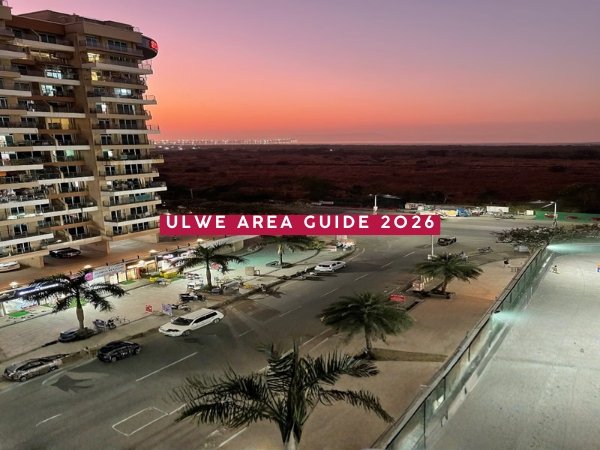
If you’ve driven across the Atal Setu in the last year, you’ve already been to the edge of Ulwe — the bridge’s descent road in Navi Mumbai pours traffic straight into Ulwe’s Sector 8. That single fact is why this once-sleepy coastal village is now the most talked-about node in Navi Mumbai. It sits minutes from the new international airport, it’s wired directly into South Mumbai by the country’s longest sea bridge, and a 2BHK here still costs noticeably less than the same flat in Kharghar or Vashi.
This Ulwe area guide cuts past the brochure language. Here’s where to actually buy, what it costs in 2026, how you’ll get around, and the things builders won’t tell you.
Where Is Ulwe?
Ulwe is a CIDCO-planned node at the southern edge of Navi Mumbai, technically falling in Raigad district (pincode 410206), right beside Panvel. A decade ago it was farmland and fishing hamlets. Today it’s a grid of wide sector roads, new towers, and a population pushing 1.7 lakh.
Three things define its geography: the Arabian Sea on its western flank, the Navi Mumbai International Airport (NMIA) just to the south, and the Atal Setu (MTHL) landing on its northern doorstep. Everything good about Ulwe flows from sitting at the intersection of all three.
Why Ulwe Is Navi Mumbai’s Fastest-Rising Node
Atal Setu lands here. The Mumbai Trans Harbour Link’s descent feeds directly toward Ulwe, cutting the drive to South Mumbai (Sewri) to roughly 20 minutes. AC buses like the 116AC already run Mantralaya–Kharkopar via the bridge.
The airport is 10–15 minutes away. NMIA is operational, and Ulwe is one of the closest residential nodes to it. Airport jobs are already creating rental demand on the ground.
Jio Institute is already here. Reliance Foundation’s Jio Institute — an Institute of Eminence — runs from a 52-acre campus overlooking the sea in Sector 4/5. It’s not “coming”; it’s live, with postgraduate batches and a 360,000 sq ft built campus. Its presence is exactly why the western sea-facing belt is Ulwe’s most aspirational address.
Ramsheth Thakur International Sports Complex (RTISC). Spread across 17.5 acres, RTISC gives Ulwe something most new nodes lack — a genuine recreation anchor: four indoor badminton courts, astro-turf tennis, squash, a swimming pool, gym, spa, banquets and a restaurant. For a family deciding between nodes, this matters.
Best Sectors in Ulwe — Where to Actually Buy
Ulwe runs on a sector system, and the price and feel change sharply from one to the next. Here’s the honest breakdown:
Sector 8 (sea-facing) — the prime pocket. This is where the Atal Setu descent meets the coast, on a 300-ft-wide road. Sea-side flats here combine the best views with the fastest exit toward the bridge and Mumbai. If you want one address in Ulwe, this is it.
Sectors 4–5 (near Jio Institute) — the institutional sea belt. Quieter, greener, anchored by the Jio campus. Premium feel, walk-to-station access via Bamandongri.
Sectors 17–20 (airport-side) — the appreciation play. Closest to NMIA, some plots border the airport zone. Newer stock, strong long-term upside, but still maturing on daily amenities.
Sectors 1–8 (broadly) — entry-level value. Generally the most headroom for price growth as infrastructure completes.
While coming from South Mumbai – best route to drive your car and enjoy some good spots to hangout.
Ulwe Property Rates 2026
Configuration
Typical Price Range (2026)
1 BHK
₹45–65 lakh
2 BHK
₹60–90 lakh
Average rate
~₹14,700–14,850 / sq ft
2 BHK monthly rent
₹18,000–28,000
Rental yield
~3–4%
The pattern that matters: Ulwe sits roughly 15–20% below Kharghar and 30–40% below Vashi for comparable, newer construction. Appreciation has run about 12% over three years and 20% over five, with analysts projecting 8–12% a year as the airport scales and the metro arrives.
⚠️ Property rates move fast in airport-zone nodes — treat these as a 2026 snapshot and verify current per-sq-ft rates with two local sources before you transact.
Getting Around — Trains, the Bridge & the Coastal Road
Local trains: Ulwe is served by Bamandongri and Kharkopar stations on the Nerul–Uran suburban line, running toward Seawoods, Nerul and Belapur — and onward into the Harbour line to CSMT. Around 40 services run daily.
Atal Setu: the bridge descent into Sector 8 is the headline connection to South Mumbai. For the full route, entry/exit points and toll, see our Atal Setu Directions & Toll Guide.
Ulwe Coastal Road: CIDCO’s 5.8 km coastal road, plus a 0.9 km link to the NMIA terminal, is targeted for completion around late 2026 and will give a near-direct Atal Setu → airport route, saving roughly 25 minutes.
Metro: Ulwe doesn’t have a metro station yet. The Navi Mumbai Metro is extending toward the airport, with the Ulwe corridor expected to benefit around 2027–28 — a likely trigger for the next price jump.
Schools, Hospitals & Daily Life
Schooling inside the node is reasonable — Radcliffe School and Indian Model School are within Ulwe, alongside the Jio Institute for higher education. For healthcare, day-to-day clinics like Feenixx and Om Sai cover basics, but the nearest multi-specialty hospitals (Medicover Kharghar, Apollo CBD Belapur, MGM Kamothe) are a 20–30 minute drive — a genuine consideration for families with elderly members.
Daily life leans calm and green: wide roads, sectoral parks for morning walks, NMMT buses threading the sectors, and auto-rickshaws filling the gaps.
The Honest Downsides
Public transport isn’t mature yet. No metro, and the two railway stations are useful but not central to every sector — most residents still depend on a vehicle.
Healthcare depth is limited within the node itself.
Construction dust and drainage on some inner service roads remain real complaints in resident reviews.
Parking gets tight around the main market stretch.
Who Ulwe Is Right For
Investors with a 3–5 year horizon: strong yes. The airport-plus-metro story is the clearest appreciation play in Navi Mumbai right now — see how it ranks against other nodes in our Best Areas to Live in Navi Mumbai comparison.
End-users who want infrastructure ready today: Kharghar is more comfortable — but you’ll pay 15–20% more for it. If you want space and value instead, neighbouring Panvel is worth a look.
Sea-facing aspirational buyers: Sector 8 and the Jio Institute belt (Sectors 4–5) are the addresses to chase.
Ulwe is, simply, Navi Mumbai betting on its own future — and getting in now means buying before the metro confirms what the airport already started.